

How To Set Up A Primo Water Dispenser
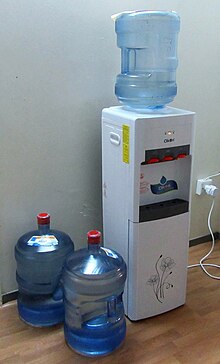
A h2o dispenser, known as water cooler (if used for cooling merely), is a motorcar that dispenses and oftentimes besides cools or heats up water with a refrigeration unit. Information technology is commonly located near the restroom due to closer access to plumbing. A drain line is as well provided from the water cooler into the sewer organisation.
Water dispensers come in a variety of form factors, ranging from wall-mounted to bottle filler water dispenser combination units, to bi-level units and other formats. They are generally cleaved up into two categories: signal-of-utilise (POU) water dispensers and bottled water dispensers. POU h2o dispensers are connected to a water supply, while bottled water dispensers crave delivery (or cocky-option-up) of h2o in big bottles from vendors. Bottled water dispensers tin exist top-mounted or lesser-loaded, depending on the design of the model.
Bottled water dispensers typically use xi- or 22-liter (5- or 10-gallon) dispensers commonly found on height of the unit of measurement. Pressure coolers are a subcategory of water dispensers encompassing drinking water fountains and directly-piping water dispensers. Water cooler may also refer to a primitive device for keeping water cool.[1]
Dispenser types [edit]

Wall-mounted h2o dispensers
Wall-mounted / recessed [edit]
The wall-mounted type is continued to the building's h2o supply for a continuous supply of water and electricity to run a refrigeration unit to cool the incoming water, and to the building'due south waste product disposal system to dispose of unused water. Wall-mounted water coolers are frequently used in commercial buildings like hospitals, schools, businesses, and other facilities where a facility manager is nowadays to monitor its installation and maintenance.
In the standard wall-mounted libation, also commonly referred to as a water fountain or drinking fountain, a small tank in the motorcar holds chilled water so the user does non take to await for chilled h2o. Water is delivered by turning or pressing a button on a spring-loaded valve located on the top of the unit, that turns off the h2o when released. Some devices as well offer a big push button on the front end or side. Newer machines may not have a button at all; instead, a sensor that detects when someone is most and activates the water. H2o is delivered in a stream that arches up, allowing the user to drink directly from the top of the stream of water. These devices usually dispense water directly from the municipal water supply, without treatment or filtering.
Wall mountain water coolers come up in a broad variety of styles, from recessed models to splash resistant, contoured basins protruding out from the wall, traditional rounded square edge designs, canteen filler and water cooler combination units, bi-level designs, with other features and options. These are sometimes installed to meet local, state or federal codes.
Bottom-load water dispenser [edit]
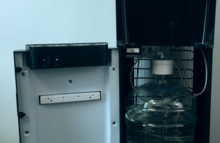
Bottom load water dispenser revealing 5-gallon bottle, with cabinet opened
Water dispensers commonly accept the water supply vessel mounted at the top of the unit. Bottom-load water dispensers take the vessel mounted at the bottom of the unit to make loading easier.
Tabletop water dispenser [edit]

At that place are too smaller versions of the water dispensers where the dispenser tin exist placed directly on superlative of a tabular array. These dispensers are commonly classified every bit household appliances and tin can often exist establish in household kitchens and part pantries.
Straight-piping water dispenser (POU) [edit]
Water dispensers can exist direct connected to the in-business firm water source for continuous dispensing of hot and cold drinking water. It is usually referred to every bit POU (point of use) water dispensers. POU units are generally more than hygienic than bottled water coolers, provided the stop user has admission to clean h2o sources.[2]
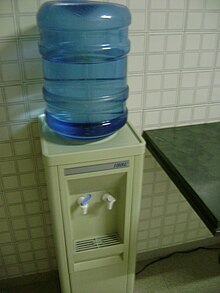
Freestanding water cooler with a bottle
Freestanding [edit]
A freestanding design generally involves bottles of water placed spout-down into the dispensing machine.
Tabletop or kitchen worktop versions are bachelor which apply readily bachelor five-liter water bottles from supermarkets. These coolers use air pumps to push button the h2o into the cooling sleeping accommodation and Peltier devices to chill the water.
New development within the water cooler market place is the appearance of countertop appliances which are connected to the mains and provide an instant supply of not just chilled water simply likewise hot and humid h2o. This is often visible in the horeca industry.
Water will flow faster when the handle is in the upright position. The water is aerated which allows the h2o to come through the spout at a faster rate.
Water source [edit]
Water dispensed from h2o coolers may originate from many unlike sources, but are often classified into ii major categories, namely natural mineral and spring water, and purified water.[3]
Natural mineral and jump water [edit]
Natural mineral and leap water are waters emanating from secret geological rock formations collected from boreholes or emerging springs. Legislation in each corresponding country further differentiates betwixt these two types of h2o and stipulates strict naming and labeling criteria based on natural source protection, full dissolved solids, and the amount of processing the h2o may undergo prior to bottling.
Purified water [edit]
Purified water is water from groundwater or municipal h2o supply and is produced by any 1 of several methods of purification including reverse osmosis, distillation, deionization, and filtration. The h2o is often treated past ultraviolet calorie-free or ozone for antimicrobial reasons and re-mineralized past injection of soluble inorganic salts.
H2o delivery [edit]
The delivery of water in a h2o cooler comes in two main forms, namely bottled variants, or plumbed directly from the primary h2o supply. The water is normally pumped into a water tank to exist heated or chilled, depending on the model of the water cooler. Modern versions include hybrid models that are able to utilise both methods.
Bottled water coolers [edit]
To install the canteen, the bottle is tipped upside down and prepare onto the dispenser; a probe punctures the cap of the canteen and allows the water to flow into the machine's internal reservoir. These gravity-powered systems have a device to dispense water in a controlled style.
These machines come up in different sizes and vary from tabular array units, intended for occasional use to flooring-mounted units intended for heavier use. Bottled water is normally delivered to households or businesses on a regular footing, where empty returnable polycarbonate bottles are exchanged for full ones. In developing markets, PET is oft used for large bottles despite shrinkage and lower washing temperature will lead to making it a more challenging material to use.
The bottle size varies with the size of the unit, with the larger versions in the US using v-US-gallon (19 L) bottles. This is as well the most common size elsewhere, labeled as eighteen.9 liters in countries that use the metric organisation. Originally, these bottles were manufactured at 3,v or 6 US gallon chapters (11.4, 18.9 or 22.7 liters) and supplied to rented water cooler units.[four] These units usually do non accept a place to dump excess water, only offering a pocket-size basin to catch pocket-size spills. On the front, a lever or pushbutton dispenses the water into a cup held beneath the spigot. When the water container is empty, it is lifted off the top of the dispenser, and automatically seals to forbid any excess h2o still in the canteen from leaking.
Textile [edit]
For many years and throughout the 20th century, glass was the primary material used for bottling until the evolution of thermoplastics following World War II. PVC evolved equally a multi-purpose plastic textile and gained mass adoption as an ideal mass production material. Only dark green glass bottles were retained for packaging carbonated waters. The 1980s saw the re-evolution of PVC bottles due to toll reduction. Advances in manufacturing and materials technology such as new blow and injection molding techniques take reduced the wall thickness and weight of bottles while improving immovability and increasing service life.
Straight plumbed [edit]
Directly plumbed h2o coolers employ tap h2o and therefore exercise not demand bottles due to their utilise of the main water supply. Commonly, some method of purification is used. Log reduction (east.g. 6-log reduction or 99.9999% effective) is used as a measure out on the effectiveness of sanitization and disinfection.
Purification [edit]
Filtration [edit]
Filtration methods include reverse osmosis, ion exchange, and activated carbon. Reverse osmosis works differently from chemical or ultraviolet protection, using a membrane that has fine pores, passing HtwoO while preventing larger molecules such as salts, carbonates, and other micro-organisms from passing through it. If at that place is insufficient energy to naturally force the water through the membrane, a powerful pump is required, resulting in potential loftier energy costs. In addition, RO units are capable of softening water. Some living micro-organisms, including viruses, are capable of passing through an RO unit filter.[five]
Deionizers or demineralizers use resins exchange to remove ions from the stream of water and are most commonly twin-bed or mixed-bed deionizers. Information technology is oftentimes used in sterile manufacturing environments such as estimator fries, where deionized water is a poor conductor of electricity.
In activated carbon, raw materials such as lignite, coal, bone charcoal, kokosnoot shells, and wood charcoal are used, developing pores during activation when partly burning away carbon layers. In most cases, activated carbon is a single-use cloth as regeneration is often not possible on-site. Granular activated carbon (GAC) is most commonly used in the filtration of the water cooler. Regular sanitization using hot water and steam is required to limit bacterial growth.
Sanitization & disinfection [edit]
The sanitization of h2o is divers past the reduction of the number of micro-organisms to a safety level. According to the AOAC intermission exam method, a sanitizer should be capable of killing 99.999% of a specific bacterial test population within 30 seconds at 25°C (77°F). Sanitizers may or may not necessarily destroy pathogenic or disease-causing leaner. The sanitizer used must comply with regulations applicable in the geographic location. In the U.s., sanitizers are regulated by the EPA and FDA, and must pass the AOAC examination in the reduction of microbial activity of two standard test organisms (Staphylococcus aureus and Escherichia coli) from a designated microbial load by a v-log reduction.
The principal divergence between a sanitizer and a disinfectant is that at a specific use dilution, the disinfectant must have a college impale capability for pathogenic bacteria than that of a sanitizer. If these micro-organisms are not destroyed, the bottled h2o existence produced may be contaminated.
UVGI (ultraviolet germicidal irradiation) is a commonly used disinfection method to kill or inactivate micro-organisms and leaving them unable to perform vital cellular functions. Drawbacks to UV light water purifiers include turbidity. If the fluid is unclear, the UV light will not laissez passer through completely, leaving the stream partially sterilized.
Cooling and heating methods [edit]
Cooling [edit]
Most modern units offering a refrigeration role to arctic the water, using Vapor pinch refrigeration or Thermoelectric cooling.
Vapor pinch refrigeration [edit]
Water coolers using vapor compression refrigeration come up in one of the following systems:
- Reservoir Arrangement - A tank where water is held, to be used for cooling or heating and is fitted with a float machinery to prevent flood.
- Removable Reservoir - a removable reservoir is an open-end tank with cooling coils that come into contact with the external tank surface. It operates on the basis of a modular system, assuasive one to easily detach and refill water instead of keeping it in a closed system. 1 of the advantages in using a removable reservoir is the ease of sanitization. This allows finish users to supplant the reservoir completely rather than sending an entire h2o cooler back for servicing. A similar technology can exist establish in many modern h2o dispensers and coffee machines.
- Stainless Steel - open up finish tank with cooling coils that come into contact with the external tank surface
- Pressure Vessel Direct Chill System - The combination of a pressure vessel, which protects the water in the tank from air-borne contamination, and a directly chill arrangement which cools water coming from the mains rapidly.
- Pressure Vessel - A sealed pressure vessel is filled at a lower force per unit area within the water cooler. Every bit such, the h2o does non come up into contact with the atmosphere, allowing a larger amount of common cold water (depending on the size of the tank) to be dispensed at the expense of a slower cooling arrangement.
- Direct Arctic - In a standard direct chill system, water is passed through a stainless steel curl that is in contact with a copper evaporator that circulates refrigerant gas. The refrigeration arrangement is attached outside of the coil and the cold transfers through the pipe walls to chill the water in the coil through conduction. When the taps are operated, the chilled water is dispensed at mains pressure. The water never comes into contact with the atmosphere as the common cold temperature emitted by the refrigerant gas is transferred through the copper roll which transfers the cold temperatures to water passing through the stainless steel coil without touching each other. This allows the water to get cold more quickly once again at the expense of having a lower book of cold h2o available.
- Water ice-depository financial institution Cooling System - A pressurized stainless steel roll and a copper roll is immersed in a reservoir full of pre-chilled water. The copper whorl containing the refrigerant gas freezes the h2o contained inside the reservoir producing a cold supply, which in turns cools the drinking water flowing through stainless steel curl.
Thermoelectric cooling [edit]
Thermoelectric cooling is a green alternative to HFC refrigerant that uses a solid state device that acts equally a oestrus pump to transfer heat from one side of the device to another using the Peltier event. It is made upward of numerous pairs of semiconductors enclosed by ceramic wafers. Thermoelectric coolers use direct current power rather than refrigerant gas and a compressor and have no moving parts or circuitous assemblies.
Heating [edit]
Some versions too have a 2d dispenser that delivers room-temperature water or fifty-fifty heated water that tin exist used for tea, hot chocolate or other uses. The water in the alternate hot tap is mostly heated with a heating chemical element and stored in a hot tank (much like the traditional hot h2o heaters used in residential homes). Additionally, the hot tap is usually equipped with a push-in rubber valve to prevent burns from an accidental or inadvertent pressing of the lever.
Additional features [edit]

Modern variant with bottle filling functionality
Bottle filler [edit]
Newer variants of water coolers include an additional dispenser designed to fill water bottles directly on wall-mounted units. This is increasingly mutual in public water coolers as they have also been spotted in public places such every bit airports[6] [vii] and railway stations.[8] These bottle filling units also can indicate the number of single-use plastic bottles saved every bit function of an ongoing public effort to reduce plastic pollution.
Carbonation [edit]
Modern variants of water coolers have been equipped with options for sparkling h2o every bit a event of increasing demand for carbonated beverages and also a greater sensation to good for you living, resulting in preference for carbonated water over sweetened carbonated beverages.[9] This works with the addition of a mixer tank filled with compressed COii located inside the cooling tank. This brings the temperature of the COii gas down to the temperature of the cooling tank. As carbonated water is dispensed, the mixer tank is automatically refilled with common cold water and carbon dioxide, ensuring a continuous supply of carbonated water is readily available.
Maintenance [edit]
All bottled water coolers demand to exist periodically cleaned to forestall mineral build-up inside the heating tank, also known equally scaling. The frequency of the cleaning can exist adamant past the concentration of the minerals and the amount of water used. Descaling agents such as citric acid can be used for this cleaning process.
Heating tanks will crave cleaning when normal hot water menstruation appears to be restricted or when noisy heating cycles can exist heard during functioning. Additional symptoms include h2o coming from the cooling tank is very warm also as a change of gustation in the water resulting from mineral build-up.
Encounter likewise [edit]
- Drinking fountain
- Instant hot h2o dispenser
- International Bottled Water Association
- Refrigerator with congenital-in water dispenser.
- Soda fountain
- Tutedhara
- Vending machine
References [edit]
- ^ "Water cooler". Horniman Museum and Gardens. Retrieved 2015-07-twenty .
- ^ "Water Coolers and Water ice - Making Machines Policy" (PDF). Regal Devon and Exeter NHS Foundation Trus. 2022-01-xiii. Retrieved 2018-02-25 . [ dead link ]
- ^ Senior, Dorothy (2011). Dege, Nicholas (ed.). Engineering of Bottled Water (tertiary ed.). Chichester, UK: Blackwell Publishing Ltd. p. 299. ISBN978-1-4051-9932-2.
- ^ Senior, Dorothy (2011). Dege, Nicholas (ed.). Technology of Bottled Water (third ed.). Chichester, UK: Blackwell Publishing Ltd. p. 8. ISBN978-1-4051-9932-two.
- ^ Reid, Robert (2004). Water Quality and Systems: A Guide for Facility Managers (2nd ed.). Georgia, The states: The Fairmont Press. p. 187. ISBN0-88173-332-six.
- ^ Yamanouchi, Kelly (2013-06-21). "Water bottle filling stations coming to airport". The Atlanta Periodical-Constitution . Retrieved 2018-08-28 .
- ^ Brockman, Joshua (2017-11-20). "Instead of That $5 H2o Canteen at Airports, Filling Stations". The New York Times . Retrieved 2018-08-28 .
- ^ "Scotland's railway stations to offer drinking h2o". BBC News. 2022-01-25. Retrieved 2018-08-28 .
- ^ Squad, Trefis (2014-01-xiv). "Coca-Cola Eyes Growth In The Sparkling Bottled Water Market". Forbes . Retrieved 2018-08-28 .
External links [edit]
 Media related to H2o coolers at Wikimedia Commons
Source: https://en.wikipedia.org/wiki/Water_dispenser
0 Response to "How To Set Up A Primo Water Dispenser"
Post a Comment